From Concept to Consumer: Trends in Molded Firearm Components for 2025

Molded firearm components are evolving quickly, with demand for lightweight, customizable parts leading the charge. Today’s firearm operators expect performance, personalization, and precision requirements that Pacific Plastic Technology meets with scalable plastic injection molding services.
The commercial firearms market is increasingly focused on lightweight, durable, and modular designs, many of which are only possible through precision plastic injection molding. Pacific Plastic Technology supports this shift with fast, scalable tooling, in-house design, and expertise in molding polymers and hybrid materials to tight tolerances.
Whether you’re launching a new firearm platform or updating a legacy design, our team helps OEMs move from concept to production with confidence.
A Growing Market for High-Precision Components
Firearm manufacturers replace metal components with polymer and MIM alternatives to reduce weight and cost without compromising performance. This growing trend increases the demand for precision-molded parts in components like triggers, safeties, and slide internals. Here are a few reasons for the increasing trend:
High-Performance Polymers: Engineering-grade thermoplastics like glass-filled nylon and carbon fiber-reinforced polymers offer excellent heat resistance, structural stability, and impact strength. These materials outperform legacy plastics, especially in critical parts like grip frames, handguards, and stocks.
Hybrid and Transparent Compounds: Some polymers now offer glass-filled strength with optical clarity, allowing for new see-through accessories. Hybrid parts that combine metal and molded plastic (like polymer overmolded triggers or core-reinforced rails) are also gaining traction for their balance of strength and reduced mass.
Modular Designs: From adjustable buttstocks to interchangeable grip panels, shooters expect modular platforms that they can configure to fit their hands, mission, or preferences. Injection molding makes it cost-effective to produce swappable components in a variety of sizes, textures, and colors.
Improved Ergonomics: Design flexibility in molding enables grip stippling, index guides, trigger undercuts, and other ergonomic enhancements. OEMs are increasingly investing in designs that reduce fatigue and improve handling.
Weight Reduction: Lightweight construction remains a top priority. Injection-molded components can reduce the weight of a firearm by 10–30% compared to their metal counterparts. Manufacturers of compact carry pistols, youth rifles, and lightweight hunting platforms value lower weight.
Why OEMs Turn to Pacific Plastic Technology
In-House Tooling Design
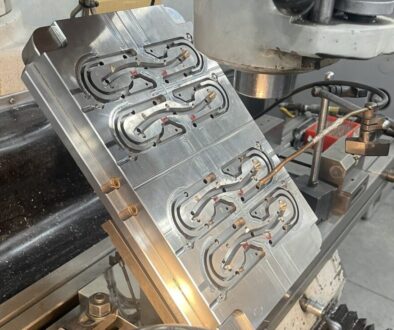
From prototyping to production tooling, our engineers collaborate with your team to create cost-effective molds for:
- Highly detailed geometries
- Insert and overmolded parts
- Short-run and mid-volume production
Scalable, Responsive Manufacturing
We support:
- Short test runs and pilot programs
- Seasonal or color variant launches
- Scaled growth into higher volumes
With rapid tooling changeovers and flexible scheduling, we meet your deadlines without sacrificing quality.
Material Expertise
Whether you’re working with:
- Carbon- or glass-filled nylon
- Thermoplastic elastomers (TPE)
- MIM-polymer hybrids
We maintain consistent processing and dimensional control to meet exacting standards for firearm components.
What These Trends Mean for OEMs
In 2025, OEMs must adapt quickly to consumer preferences while complying with changing regulations. That means working with partners who can prototype fast, mold complex parts, and scale production efficiently.
Pacific Plastic Technology delivers on all three.
If you’re launching new platforms, customizing polymer firearm parts, or seeking a responsive molding partner, contact Pacific Plastic Technology.
Contact us to discuss tooling design, materials, and scalable production tailored to your needs.