Inside Pacific Plastic Technology’s Tooling Playbook: Design Choices That Cut Cycle Time
In injection molding, cycle time is the heartbeat of profitability. Every second trimmed from the mold’s open‑close‑cool sequence compounds into major gains: lower part cost, higher throughput, and more predictable delivery schedules. At Pacific Plastic Technology, we treat tooling design as an engineering discipline, not a commodity. The decisions made long before steel is cut, including runner strategy, cooling layout, steel selection, and maintenance planning, directly determine how efficiently a mold will run for years to come.
This is a look inside PPT’s tooling playbook and the design choices that consistently reduce cycle time while protecting long‑term ROI.
Hot vs. Cold Runners: Choosing the Right Flow Strategy
PPT utilizes both hot runner and cold runner systems, selecting the right approach based on resin behavior, part geometry, cosmetic requirements and total cost of ownership.
Hot Runner Systems: Faster Cycles, Less Waste
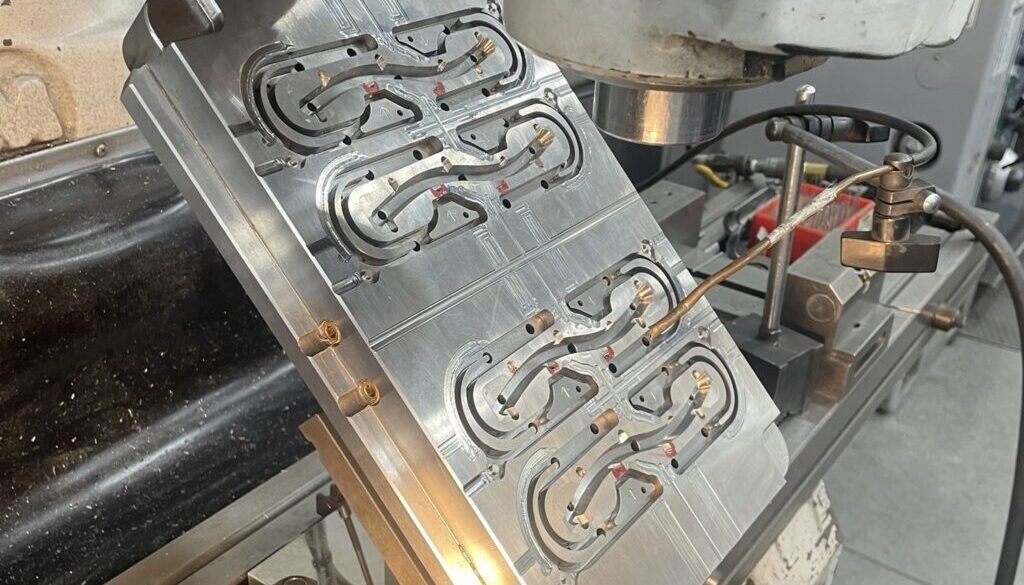
Hot runners keep resin molten inside thermally controlled channels. The small copper‑colored tubes you’ll see inserted into a mold plate are part of this system and they maintain temperature and deliver plastic directly into the cavity without creating a traditional runner.
Why engineers choose hot runners
- Shorter cycle times due to reduced cooling mass
- No runner waste, improving material efficiency
- Better gate cosmetics and reduced vestige
- More consistent fill across multi‑cavity tools
Hot runners shine in high‑volume programs where material cost and cycle time dominate the ROI equation.
Cold Runner Systems: Simpler, Robust, and Cost‑Effective
Cold runners allow resin to cool and solidify in the runner channel, which is then ejected along with the part.
Cold runners are an excellent tool because they have lower upfront tooling cost, are easy to maintain, are ideal for short‑run or multi‑material programs, and are highly reliable for commodity resins. PPT engineers evaluate both systems through a cost‑per‑part lens—not just tooling price. In many cases, a well‑designed cold runner tool can outperform expectations when paired with optimized cooling and gating.
Conformal Cooling: The Biggest Cycle‑Time Lever Most Molders Ignore
Traditional cooling lines are straight gun‑drilled channels. They work but they rarely follow the true geometry of the part. This leads to hot spots, uneven cooling, and longer cycles.
Conformal cooling, enabled by additive manufacturing, changes the game.
Conformal cooling has up to 30–60% cycle‑time reduction depending on part geometry and has more uniform cooling, reducing warp and improving dimensional stability. It also has a better surface finish due to controlled thermal gradients, and there’s less scrap and rework. For complex housings, thick‑to‑thin transitions, or cosmetic parts, conformal cooling often delivers the fastest ROI of any tooling upgrade.
Steel Choices: Strength, Thermal Conductivity, and Longevity
Tool steel selection is more than a hardness spec—it’s a strategic decision that affects cycle time, mold life, and part quality.
Common steel choices in PPT’s tooling library
- P20: Versatile, cost‑effective, ideal for medium‑volume production
- H13: High‑strength, heat‑resistant, perfect for abrasive resins or high‑pressure molding
- S7: Excellent toughness for high‑impact applications
- Beryllium Copper (BeCu) Inserts: Exceptional thermal conductivity for hot spots or deep ribs
High‑conductivity materials like BeCu can pull heat out of thick sections dramatically faster than steel alone. PPT often uses hybrid construction; steel for durability, copper alloys for thermal performance. This balances longevity and speed.
ROI: The Real Scorecard for Tooling Decisions
Cycle time is only one part of the ROI equation. PPT evaluates tooling choices across the full lifecycle.Here’s what we look at:
1. Cost per part
Hot runners, conformal cooling, and premium steels may increase upfront cost but reduce long‑term part price.
2. Scrap reduction
Better cooling and gating reduce warp, sink, and short shots.
3. Maintenance and uptime
Simpler designs reduce downtime; advanced systems reduce rework.
4. Program longevity
A tool that runs millions of cycles with minimal intervention delivers exponential value.
5. Material efficiency
Both hot runners and optimized cold runners reduce waste, they just do it in different ways. Both result in tooling that pays for itself faster and keeps paying dividends for the life of the program.
Why Pacific Plastic Technology Invests Heavily in Tooling Engineering
PPT’s tooling philosophy is simple: better tools make better parts. By combining hot and cold runner expertise, advanced cooling strategies, smart steel selection, and engineering‑driven collaboration with customers, PPT delivers molds that run efficiently, predictably, and profitably. If you’re developing a new part or looking to reduce cost on an existing program, our team can evaluate your design, material, and production goals to recommend the right tooling strategy.