Mold Maintenance as a Strategy: Extending Tool Life & Part Quality
How PM schedules, wear tracking, and Mean Time Between Service (MTBS) protect your tooling investment and keep parts running at peak quality.
Injection molds are among the most valuable assets in any molding operation, often representing $10,000 to $100,000+ in capital investment before the first production shot ever runs. Protecting that investment requires more than occasional cleaning or emergency repairs. It requires a strategic, data‑driven maintenance program designed to catch wear early, prevent defects, and maximize uptime.
At Pacific Plastic Technology, we treat mold maintenance as an engineering discipline. Here’s how structured PM schedules, wear tracking, and MTBS analysis work together to extend tool life and ensure consistent part quality.
Why Mold Maintenance Matters
Injection molds operate under extreme conditions: high pressures, cyclic thermal loads, abrasive resins, and constant mechanical motion. Without proactive care, these forces lead to predictable failure modes:
- Ejector pin galling or seizure
- Cooling channel scaling that increases cycle time
- Cavity corrosion from condensation or resin gases
- Parting line wear that causes flash
- Spring fatigue and ejector misalignment
Reactive maintenance, which is fixing problems after they appear, costs 5 to 10 times more than preventive maintenance. And it often triggers unplanned downtime, which adds more to the expense.
1. PM Schedules: The Backbone of Mold Longevity
A strong PM program is built around shot‑count‑based scheduling, not calendar dates. Molds and presses wear according to how many cycles they run; not how many weeks have passed.
Daily / End‑of‑Shift Checks
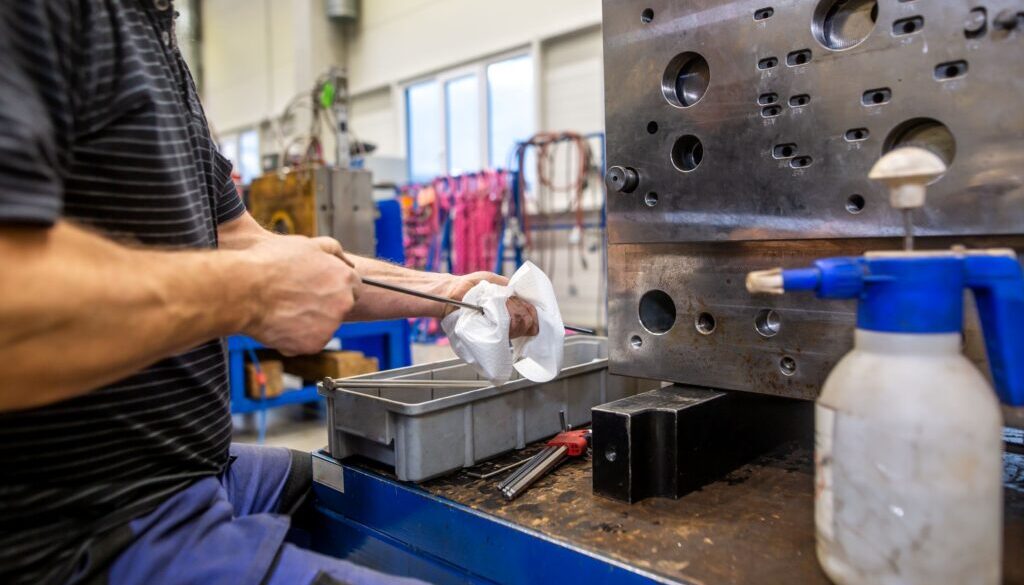
Operator‑level inspections that catch early signs of wear by checking the parting line and cavity, checking the ejector pin function, inspecting and cleaning the vent, verifying the coolant flow and logging the shot count.
Weekly Technician Maintenance
Weekly maintenance should include lubricating the guide pillars, bushings, pins, and slides, inspecting the water lines and mold connections, cleaning the vents and parting surfaces, and checking for leaks or contamination.
Shot‑Count Milestones (Core PM Intervals)
These are the most important checkpoints:
- Lubricate ejector pins every 5,000-10,000 shots
- Inspect ejector pins for wear every 50,000 shots
- Descale cooling channels every 50,000-100,000 shots
- Re‑verify critical dimensions at major milestones
Annual / Full Overhaul
Once a year a complete teardown and inspection should be done that includes cavity polishing, cooling channel cleaning, slide and lifter rebuild, seal and spring replacement, and dimensional re‑qualification.
2. Wear Tracking: Turning Data Into Predictability
Every mold should have a maintenance logbook, either digital or physical, that records:
- Shot counts
- Repairs and part replacements
- Dimensional checks
- Cooling performance
- Surface condition
- Any defects observed during production
This data reveals wear patterns such as which cavities degrade fastest, when ejector pins typically begin galling, how quickly cooling channels accumulate scale, and whether certain resins accelerate corrosion. Wear tracking transforms maintenance from guesswork into predictive scheduling.
3. Mean Time Between Service (MTBS): The KPI That Drives Reliability
MTBS is the average number of shots a mold runs between required maintenance events. It’s one of the most powerful metrics for optimizing PM schedules.
How MTBS Works
- Track every maintenance event.
- Record the shot count at each event.
- Calculate the average interval between services.
The Benefits of MTBS
- Predictability: You know when the next PM is due before defects appear.
- Cost control: You avoid emergency repairs and unplanned downtime.
- Quality stability: You maintain consistent part dimensions and surface finish.
- Tool life extension: You prevent wear from escalating into permanent damage.
A well‑maintained mold can achieve 1,000,000+ shots, while a neglected mold may fail at 200,000 shots. This dramatic difference is driven almost entirely by maintenance discipline.
4. The ROI of Strategic Mold Maintenance
Preventive maintenance delivers measurable financial benefits:
- 30-40% lower costs over 5 years
- 25% reduction in downtime
- 10-20% lower maintenance costs vs reactive repairs
- Fewer scrap parts and quality escapes
When maintenance is treated as a strategic function and not a reactive one, tooling lasts longer, part quality stabilizes, and production becomes more predictable.
Maintenance Is an Engineering Strategy
For Pacific Plastic Technology, mold maintenance isn’t a checklist; it’s a strategy. By combining structured PM schedules, detailed wear tracking, and MTBS analysis, we ensure every mold delivers maximum life, minimum downtime, and consistent part quality shot after shot.